By all indications, the dynamics of electoral politics are changing. Across democracies, voters are increasingly placing greater value on tangible achievements, accessibility, and visible leadership rather than political rhetoric, sensational headlines, or distant criticisms.
In Sokoto State, this evolving political reality is becoming more evident as Governor Ahmed Aliyu’s administration continues to leave visible footprints across the state.
Politics, especially in Nigeria, has often been dominated by noise. Politicians make fiery speeches, issue lengthy statements, and engage in endless media battles. Yet, history repeatedly shows that elections are not won solely in television studios, on social media platforms, or through political grandstanding. They are won in communities, markets, schools, hospitals, and villages where citizens experience the direct impact of governance.
Governor Ahmed Aliyu appears to understand this reality.
Since assuming office in May 2023, the governor has maintained a governance style anchored on physical presence, grassroots engagement, and aggressive project execution. From urban renewal to education, healthcare, agriculture, rural development, and security, his administration has embarked on an ambitious programme of rebuilding and restoring public confidence in government.
Across Sokoto metropolis and the rural communities, evidence of this intervention is difficult to ignore.
Infrastructure as political capital
Perhaps the most visible signature of the Ahmed Aliyu administration is the scale of infrastructural development underway across the state.
Road construction and rehabilitation projects have transformed the landscape of Sokoto. Several township roads abandoned for years have either been completed or are at advanced stages of completion. The administration has also embarked on the construction and reconstruction of strategic roads linking communities, thereby improving mobility, commerce, and access to social services.
Major urban renewal initiatives, including road dualisation, drainage construction, street lighting, and beautification projects, have significantly improved the outlook of the state capital.
For residents who had endured years of dilapidated infrastructure, these projects represent more than concrete and asphalt; they symbolize responsive governance.
Political analysts often argue that infrastructure remains one of the most visible indicators of government performance because citizens interact with it daily. In Sokoto, every completed road, bridge, and drainage system serves as a reminder of an administration actively working to improve lives.
Rebuilding education
Education, long regarded as the foundation of societal development, has also received considerable attention.
The administration has undertaken the construction and renovation of classrooms across primary and secondary schools. Thousands of furniture items have been supplied to schools, while learning materials have been distributed to enhance the teaching and learning environment.
The government has also prioritized scholarship programmes for students studying within and outside Nigeria, thereby reducing financial burdens on families and expanding access to higher education.
The recruitment of qualified teachers and the rehabilitation of educational infrastructure have further strengthened the sector.
For many parents, these interventions are not abstract policy pronouncements; they are visible improvements affecting the future of their children.
Healthcare closer to the people
Healthcare delivery remains another critical area where Governor Aliyu’s administration has recorded measurable achievements.
Numerous primary healthcare centres have been renovated, upgraded, and equipped with modern medical facilities. Secondary healthcare institutions have similarly received attention through rehabilitation works and the provision of medical equipment.
The administration has also invested in maternal and child healthcare programmes, recognizing that improved health outcomes directly influence the quality of life of citizens.
In communities where residents previously travelled long distances to access basic medical services, the upgrading of local health facilities has provided much-needed relief.
For many rural dwellers, the difference between political promises and performance is measured by whether a functioning healthcare centre exists within their community.
Agriculture and rural prosperity
As an agrarian state, Sokoto’s economy depends heavily on agriculture. Understanding this reality, the Ahmed Aliyu administration has introduced interventions aimed at boosting agricultural productivity and enhancing food security.
Distribution of fertilizers, improved seedlings, agricultural inputs, and support programmes for farmers have been central to government efforts.
The administration has also focused on empowering rural communities through various livelihood initiatives designed to increase household incomes and stimulate local economies.
These interventions have strengthened the bond between government and the rural population, a constituency that historically plays a decisive role in elections.
Security through collaboration
Security remains a major concern across Nigeria, particularly in the North-West. While security challenges persist, the Sokoto State Government has sustained support for security agencies through the provision of operational vehicles, motorcycles, communication gadgets, and logistics support.
The administration has also maintained close engagement with traditional institutions, community leaders, and security stakeholders to strengthen intelligence gathering and improve response mechanisms.
In a region confronting threats from banditry and other criminal activities, citizens often appreciate leaders who remain physically present and actively involved in finding solutions.
The politics of presence
Beyond projects, perhaps Governor Ahmed Aliyu’s greatest political advantage lies in his accessibility.
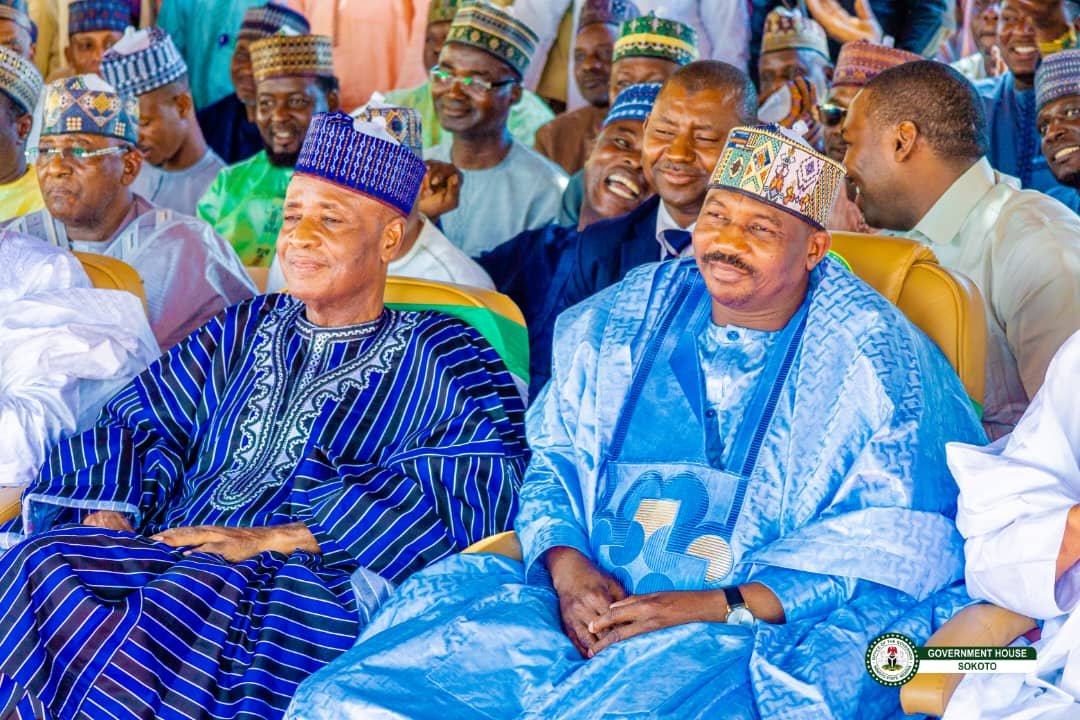
Observers note that the governor has maintained consistent interaction with communities across the state. He attends social events, receives delegations, visits project sites, and regularly engages with traditional rulers and citizens.
This visibility contrasts sharply with criticisms frequently directed at some opposition figures associated with the Aminu Waziri Tambuwal political bloc, many of whom critics argue spend little time within their constituencies.
In politics, prolonged absence can create a vacuum. I can confidently say, therefore, that the Sokoto politicians, who have chosen to reside in Abuja, rather than living with the electorates, have created a vacuum, and widened the gap that they ordinarily would have bridged.
Even the elected representatives are rarely seen among their constituents, and the public perception have gradually shifted. The Sokoto citizens have questioned their commitment, relevance, and understanding of local realities.
Absentee politics may succeed in generating media headlines, but it often struggles to inspire grassroots loyalty.
Communities naturally gravitate toward leaders they can see, access, and hold accountable.
The Wamakko factor
Beyond his administration’s performance, Governor Ahmed Aliyu enjoys a significant political advantage in the enduring influence and grassroots structure of Senator Aliyu Magatakarda Wamakko. Widely regarded as the most formidable political figure in Sokoto State, Wamakko has, over the years, built an extensive political network that cuts across the 23 local government areas of the state. His deep connection with traditional institutions, community leaders, youth groups, women associations, and party structures has continued to provide a strong political foundation for the All Progressives Congress (APC) in Sokoto. As Governor Aliyu consolidates his developmental achievements, the Wamakko political machinery remains a potent force capable of mobilising support and sustaining voter loyalty across the state.
The relationship between Governor Ahmed Aliyu and Senator Wamakko also projects continuity, stability, and trust—factors that resonate strongly with the electorate. Many voters view the governor as continuing the developmental vision and people-oriented leadership style associated with Wamakko’s political legacy. In contrast, opposition figures who are perceived as distant from their constituencies may find it difficult to counter a political structure that combines visible governance with an active and deeply rooted grassroots network. Consequently, the synergy between Governor Aliyu’s performance in office and Senator Wamakko’s enduring political influence significantly strengthens the governor’s prospects for re-election.
Why performance matters
The political lesson emerging from Sokoto is simple: performance resonates.
Roads, schools, hospitals, water projects, agricultural support, and security interventions provide concrete evidence of governance. They are visible, measurable, and directly felt by ordinary people.
While opposition criticism remains an essential component of democracy, criticism unaccompanied by sustained grassroots engagement rarely translates into electoral success.
Voters increasingly ask practical questions: Who built the road? Who renovated the school? Who provided healthcare facilities? Who remained with the people during difficult times?
The answers. Mto these questions often shape electoral outcomes.
As preparations gradually begin for future political contests in Sokoto State, one reality appears increasingly evident: in an era where citizens demand results, performance—not absenteeism or political noise—is likely to remain the strongest campaign message.
And if current developmental momentum is sustained, Governor Ahmed Aliyu may well find that the projects scattered across Sokoto’s towns and villages become his most persuasive campaign ambassadors.