Nigeria’s energy sector is entering a period of significant change, creating fresh opportunities for small businesses to adopt cleaner and more reliable power solutions.
For entrepreneurs facing rising electricity costs, grid disruptions and continued dependence on generators, Fidelity Bank Green Financing provides a practical route to improved energy security.
Recent reforms in the power sector have increased attention on electricity pricing, service reliability and decentralised energy supply. These developments are encouraging businesses and households to examine how they generate, consume and finance power.
For a small business, unreliable electricity quickly becomes a financial problem. The cost extends beyond monthly electricity bills to include fuel, generator maintenance, replacement parts, inverter batteries, interrupted operations and lost productivity.
A business owner can forecast expenses such as stock, salaries and rent. Energy is harder to predict. Grid availability may fluctuate, fuel prices may change and equipment can fail unexpectedly. This uncertainty can affect cash flow, productivity and the ability to serve customers consistently.
Nigeria’s Electricity Challenge Creates Demand for Solar Financing
The World Bank reported in 2025 that more than 80 million Nigerians, representing nearly 40 per cent of the population, lacked access to electricity.
Grid connection does not always guarantee dependable supply. Generators and inverters have consequently become part of everyday energy planning, while solar power systems are gaining attention as businesses and households seek greater control over their electricity needs.
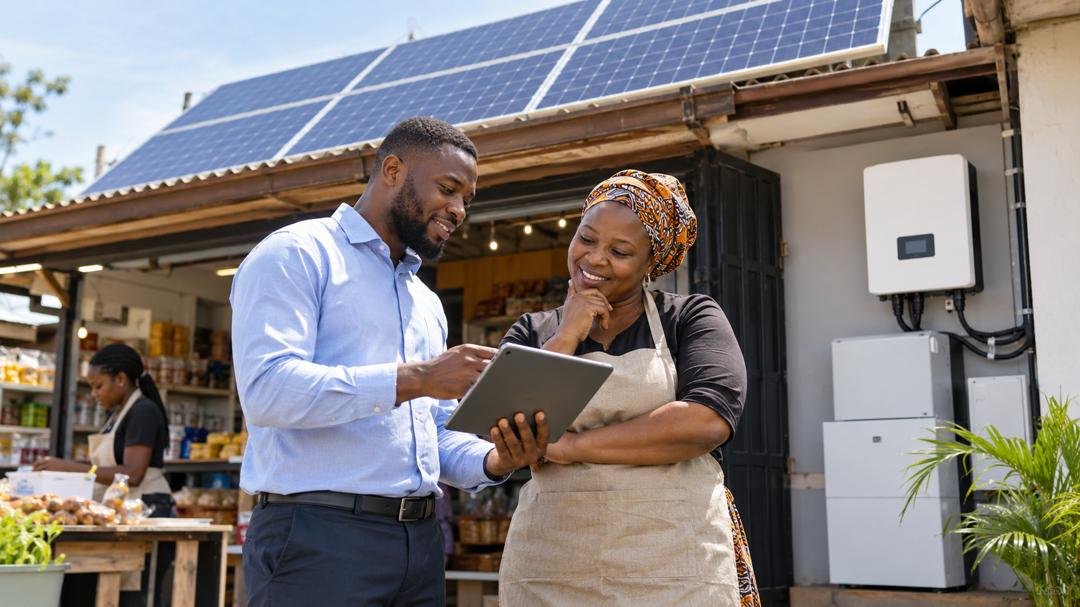
The principal barrier to solar energy adoption is often the initial cost. Solar panels, inverters and batteries can reduce generator use and improve energy independence, but many small businesses cannot conveniently pay for a complete system at once.
Fidelity Bank Green Financing helps address this challenge by enabling eligible individuals and businesses to spread the cost of solar panels, batteries, inverters and related clean energy assets.
How Fidelity Bank Green Financing Supports Small Businesses
Financing changes the question facing a business owner. Instead of asking if the company can pay for an entire solar power system immediately, the owner can assess if the monthly repayment fits within the amount already spent on fuel, maintenance and alternative electricity.
This creates a clearer basis for investment.
A suitable solar system can help a business reduce its dependence on fuel, maintain essential operations during grid outages and plan its energy expenses with greater confidence. The resulting stability can support productivity, customer service and revenue protection.
Consider a restaurant that needs continuous refrigeration, a salon that depends on powered equipment, a pharmacy managing temperature sensitive products or a small manufacturer operating production machinery. For each business, electricity reliability has a direct relationship with income.
An outage can therefore cost more than the power required to prevent it.
Fidelity Bank Green Financing connects the environmental benefits of renewable energy with the commercial realities of Nigerian businesses. It supports access to productive assets while helping customers preserve working capital for inventory, salaries and expansion.
Reliable Power Can Improve Business Productivity
Customers are usually less concerned with technical specifications than with practical outcomes.
They want to know if a solar system can power their business, how much generator use it can replace, how it will perform during an outage, how long its batteries can provide electricity and what the monthly financing obligation will be.
Effective green financing begins with these questions.
An energy system that is too small may fail to support critical equipment. A system that is unnecessarily large may increase the customer’s cost. Proper assessment of electricity load, operating hours and priority equipment can help align the financed solution with the customer’s actual requirements.
This advisory approach is particularly important for small businesses, where every investment must support cash flow and operational continuity.
The Cost of Unreliable Power Extends Beyond Fuel
The true cost of electricity includes fuel consumption, generator servicing, replacement parts, noise, downtime and lost business.
For many enterprises, the financial effect of interrupted operations can exceed the immediate cost of energy. Refrigerated goods can spoil, production may stop, appointments may be cancelled and customers may move to competitors.
Reliable power therefore provides more than convenience. It protects revenue, supports service delivery and gives business owners greater confidence to plan for growth.
Households can realise similar benefits. Predictable electricity supports lighting, refrigeration, connectivity, remote work and learning. Financing can make these benefits accessible sooner, provided the repayment structure remains affordable.
Green Energy Financing Supports Nigeria’s Economic Resilience
Nigeria’s energy transition is also a productivity and financial inclusion opportunity. Distributed renewable energy can help businesses operate with greater independence from grid disruptions while reducing reliance on fossil fuel powered generators.
This gives banks an important role in closing the gap between demand for clean energy and the initial cost of acquiring the necessary equipment.
Fidelity Bank Green Financing provides a logical response to this challenge. Its focus on solar panels, inverters, batteries and related assets gives eligible customers an opportunity to convert unpredictable energy spending into a more structured investment.
The outlook is encouraging. As awareness grows and financing becomes more accessible, more Nigerian businesses can adopt energy systems that improve reliability, control operating costs and strengthen resilience.
With dependable power, entrepreneurs can devote more attention to production, sales, innovation and customer service. Fidelity Bank Green Financing can help make that transition practical, affordable and commercially meaningful.
Written by Tolulope Rojaiye, Team Member, Brand Management, Fidelity Bank Plc