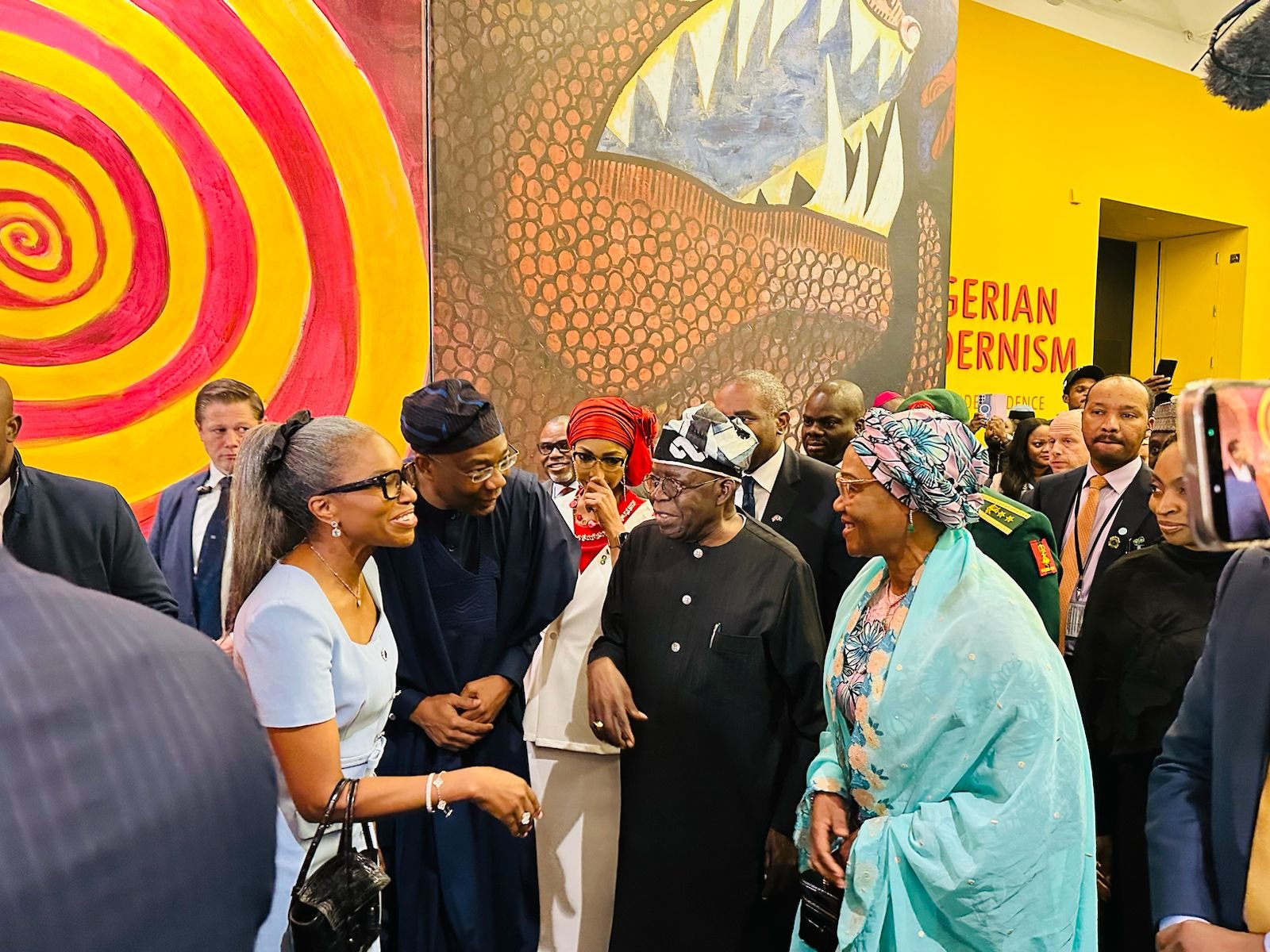
In what marked a fitting and symbolic finale to a landmark state visit to the United Kingdom, President Bola Ahmed Tinubu, GCFR, concluded his engagements with a distinguished reception at the Tate Modern, a global temple of art and ideas, where Nigeria’s cultural soul was on full display through the “Nigerian Modernism” exhibition.
The reception, attended by global dignitaries, including Deputy Prime Minister David Lammy MP, members of the diplomatic corps, business leaders, and the Nigerian diaspora, was more than a ceremonial closing. It was a powerful statement of identity, influence, and intent, an affirmation that Nigeria’s story is not only being told but is being celebrated on one of the world’s most prestigious cultural stages.
Describing the exhibition as “a testament to a revolution,” President Tinubu reflected on the bold generation of Nigerian artists who, in the mid-20th century, redefined their narrative and asserted their identity beyond colonial constructs.
“It is a profound honour to stand here… to witness the soul of Nigeria on display,” the President said. “What we see here is a people who have taken the best of global techniques and infused them with the enduring rhythms of our heritage.”
At the heart of this historic moment was the strategic partnership between Access Holdings PLC and Coronation Group, whose support brought the exhibition to life. President Tinubu commended both institutions for their visionary commitment to advancing Nigeria’s cultural diplomacy and creative economy.
“By bringing these works to London, you are not just hosting an exhibition; you are facilitating a vital dialogue between our past and our shared future,” he noted.
The evening reception captured the essence of the President’s Renewed Hope Agenda, a strategy that extends beyond economic reform to embrace the restoration and projection of Nigeria’s cultural identity as a cornerstone of national development and global engagement.
“Our creative industries: art, music, film, and literature are among our greatest exports. They represent Nigeria’s soft power in an interconnected world,” President Tinubu stated, reinforcing the role of culture as both an economic asset and a diplomatic bridge.
For many in attendance, particularly Nigerians in the diaspora, the event was deeply symbolic. Surrounded by works that embody resilience, innovation, and identity, the President called on Nigerians abroad to carry forward the same modernist spirit.
“You come from a lineage of pioneers… the ability to innovate, adapt, and lead,” he said.
The reception also underscored the enduring relationship between Nigeria and the United Kingdom, a partnership rooted in history but increasingly defined by shared aspirations in culture, commerce, and creativity.
As conversations flowed beneath the iconic industrial architecture of the Tate Modern, one message resonated clearly: Nigeria’s cultural renaissance is not a distant ambition, it is a present reality, driven by collaboration between visionary leadership and forward-thinking institutions.
“Art has no borders. It is the language of our common humanity,” President Tinubu concluded. “As we celebrate Nigerian Modernism, we also celebrate the enduring partnership between our nations and the limitless potential of human creativity.”
The evening at the Tate Modern was the end of a state visit and the closing note of a narrative that positioned Nigeria firmly at the intersection of culture, commerce, and global influence.
A historic end, indeed, to a historic visit.